Kukui Oil for Eczema and Psoriasis: Does It Really Help?
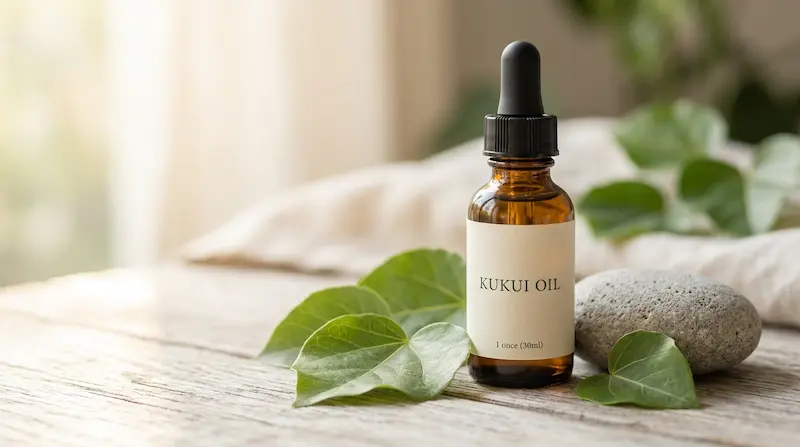
A lot is claimed online about kukui oil for eczema and psoriasis. Some sites say it “cures” eczema or “clears” psoriasis. That’s an exaggeration. In this article we give you an honest picture of what kukui oil can and cannot do.
What is eczema?
Atopic eczema (atopic dermatitis) is a chronic inflammatory skin condition in which the skin barrier is damaged. This leads to:
- Dry, flaking skin
- Redness and itching
- A compromised barrier that causes increased moisture loss
- Heightened sensitivity to irritants
Psoriasis is a different condition in which skin cells multiply too quickly, leading to scaly patches. Its causes and mechanisms differ from eczema.
Why is kukui oil recommended for eczema?
Two components in kukui oil are relevant:
1. Linoleic acid (omega-6, ~42%) Linoleic acid is a building block of ceramides, the “cement” between your skin cells. In eczema, ceramides are reduced, causing the skin barrier to “leak.” Adding linoleic acid-rich oils may help strengthen the barrier.
2. Alpha-linolenic acid (omega-3, ~29%) Omega-3 fatty acids have proven anti-inflammatory properties in skin. This may calm the typical red, irritated patches associated with eczema.
Note: Scientific evidence for using plant oils in eczema does exist, but it mostly comes from studies on linoleic acid-rich oils in general, not specifically on kukui oil. We’re careful with our claims.
What does the research say?
There is limited direct research on kukui oil for eczema. What we do know:
- Studies on sunflower oil (also high in linoleic acid) show positive effects on the skin barrier in atopic dermatitis
- Omega-3 supplementation shows anti-inflammatory effects in some skin condition studies
- Overall skin barrier repair is a recognized treatment strategy for eczema
The science supports the theoretical mechanism of kukui oil for eczema, but does not prove it directly.
How to use kukui oil for eczema
Note: Always do a patch test before applying any new product to eczema-affected skin. Apply a small amount to the inside of your wrist or a less affected area. Wait at least 24 hours.
If the patch test shows no reaction:
- After showering, apply a small amount to the affected areas
- Use on slightly damp skin for better absorption
- Massage in gently without rubbing
- Use consistently, skin barrier repair is a slow process
What kukui oil does NOT do for eczema
Let’s be honest about the limitations:
- Kukui oil does not cure eczema, eczema is a complex condition
- It does not stop the underlying inflammation the way medical treatments do
- It is not a replacement for prescribed medication (corticosteroids, tacrolimus)
- It does not help all forms of eczema or psoriasis
When to see a doctor
Always see a doctor or dermatologist if you have:
- Severe or widespread eczema symptoms
- Weeping, infected, or crusting patches
- Eczema that doesn’t respond to at-home care
- A child with eczema
Note: Use kukui oil as a complement to, not a replacement for, medical treatment. The information in this article is for informational purposes only and does not replace medical advice. Consult a doctor for serious symptoms.
Conclusion
Kukui oil can be a useful addition for eczema and dry, sensitive skin, thanks to its fatty acid profile that supports the skin barrier. However, there is limited direct clinical evidence. We recommend trying it in combination with professional guidance, not as a replacement for it.
Frequently asked questions
Does kukui oil help with eczema?
There is evidence that the fatty acids in kukui oil (particularly linoleic acid and omega-3) can strengthen the skin barrier and reduce inflammation, both relevant for eczema. However, there is little direct clinical research specifically on kukui oil for eczema. Consult a dermatologist for serious symptoms.
Is kukui oil safe for eczema?
Kukui oil is generally well tolerated, but eczema-affected skin is extra sensitive. Always do a patch test: apply a small amount to the inside of your wrist and wait 24 hours. Stop if you notice redness or irritation.
Which oil is best for eczema?
Oils high in linoleic acid are recommended for eczema, because linoleic acid is a building block of ceramides (skin barrier). Kukui oil (~42% linoleic acid), sunflower oil (~65%), and rosehip oil (~44%) are popular choices.