Fatty Acid Profile of 20+ Plant Oils Compared
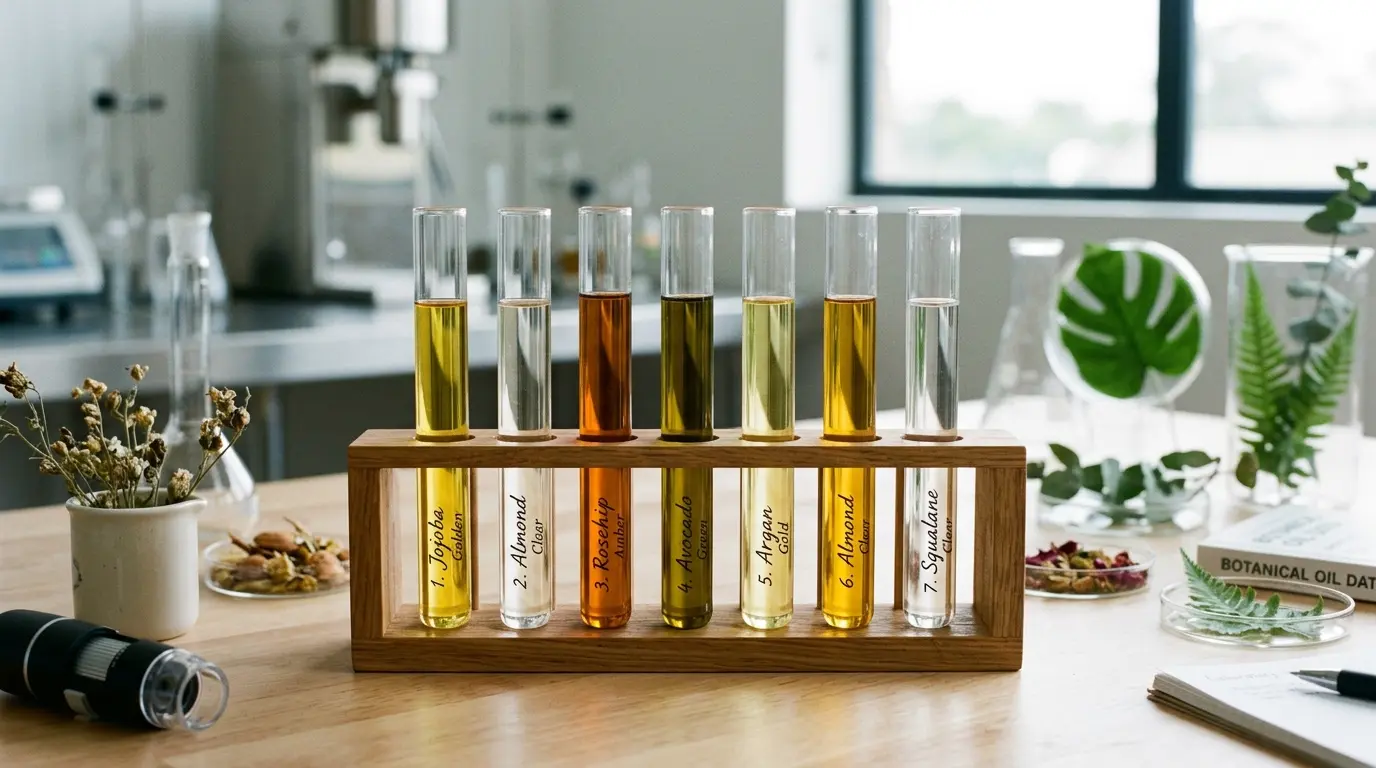
The fatty acid profile determines how an oil works on your skin. Linoleic acid repairs your barrier, oleic acid hydrates, and alpha-linolenic acid calms inflammation. In this overview we compare 20+ oils on their exact composition. More about fatty acids and skin →
What Do Fatty Acids Do for Your Skin?
| Fatty acid | Type | Main function |
|---|---|---|
| Linoleic acid (LA) | Omega-6 | Skin barrier, ceramides |
| Alpha-linolenic acid (ALA) | Omega-3 | Anti-inflammatory |
| Oleic acid (OA) | Omega-9 | Hydration, penetration |
| Palmitic acid | Saturated | Protection |
| Stearic acid | Saturated | Barrier, texture |
| Ricinoleic acid | Unique | Antimicrobial |
| Lauric acid | Saturated | Antimicrobial |
Note: Linoleic acid and alpha-linolenic acid are essential fatty acids, your body cannot produce them on its own. You need to replenish them through diet or skin care.
The Complete Fatty Acid Profile Overview
| Oil | Linoleic (ω-6) | ALA (ω-3) | Oleic (ω-9) | Palmitic | Notes |
|---|---|---|---|---|---|
| Kukui oil | 42-44% | 28-30% | 5-8% | 5-8% | Highest ω-3 of skin oils |
| Hemp seed oil | 50-60% | 15-20% | 8-15% | 6-9% | Very high ω-6 |
| Grapeseed oil | 65-75% | 0.5-1% | 14-22% | 6-8% | Highest linoleic acid |
| Rosehip oil | 35-50% | 25-35% | 14-22% | 3-5% | + vitamin A |
| Sunflower oil (HL) | 48-74% | 0-1% | 14-40% | 5-8% | Varies by variety |
| Safflower oil (HL) | 68-83% | 0-1% | 8-20% | 5-8% | Very high linoleic |
| Argan oil | 29-36% | 0-1% | 43-49% | 11-15% | High vitamin E |
| Sweet almond oil | 20-30% | 0-0.4% | 62-86% | 5-9% | Very high oleic |
| Apricot kernel oil | 20-35% | 0-1% | 58-74% | 4-7% | Mild, versatile |
| Avocado oil | 6-18% | 0-5% | 50-70% | 10-25% | + phytosterols |
| Marula oil | 4-7% | 0-0.5% | 70-78% | 9-12% | Extremely high OA |
| Tsubaki oil | 5-10% | 0-1% | 78-87% | 8-10% | Japanese beauty oil |
| Olive oil | 3-21% | 0-1.5% | 55-83% | 7-20% | Wide range |
| Macadamia oil | 1-3% | 0-1% | 55-67% | 7-10% | + palmitoleic 16-23% |
| Jojoba oil | - | - | - | - | Wax ester, no triglycerides |
| Squalane | - | - | - | - | Hydrocarbon, no fatty acids |
| Coconut oil | 1-3% | 0% | 5-10% | 7-10% | Lauric acid 44-52% |
| Babassu oil | 1-4% | 0% | 10-18% | 5-11% | Lauric acid 40-55% |
| Castor oil | 3-5% | 0.5-1% | 2-6% | 0.5-1% | Ricinoleic acid 85-95% |
| Shea butter | 3-8% | 0-1% | 40-55% | 3-7% | + stearic acid 25-50% |
| Tamanu oil | 18-31% | 0-0.5% | 34-41% | 12-18% | + calophyllolide |
Note: Jojoba oil and squalane appear in the table but have no fatty acid profile. Jojoba is technically a liquid wax, squalane a hydrocarbon. They work differently from traditional oils.
How to Use This Table
For barrier repair: choose high linoleic acid
Oils with >40% linoleic acid: kukui, hemp seed, grapeseed, safflower, sunflower. Want to see how kukui oil stacks up against specific oils? See our comparisons →
For inflammation relief: choose high omega-3
Oils with >10% alpha-linolenic acid: kukui (28-30%), rosehip (25-35%), hemp seed (15-20%). Most other oils contain almost no omega-3.
For deep hydration: choose high oleic acid
Oils with >50% oleic acid: tsubaki, marula, almond, avocado, argan, olive.
The ideal combination
The ideal skin oil has both high linoleic acid AND alpha-linolenic acid. Kukui oil is the only common skin oil that scores high on both (42% linoleic + 29% alpha-linolenic). Hemp seed oil comes second.
Oils by Skin Type
| Skin type | Look for | Recommended oils |
|---|---|---|
| Sensitive | High ω-3 | Kukui, rosehip |
| Oily/acne | High linoleic, low OA | Hemp seed, grapeseed |
| Dry | High oleic | Argan, marula, almond |
| Mature | High OA + antioxidants | Argan, rosehip, tsubaki |
| Eczema | High ω-3 + linoleic | Kukui, hemp seed |
Find which face oil suits your skin type →
Looking for the best kukui oil? See our comparison →
The information on this page is for educational purposes and does not replace medical advice. Consult a doctor or dermatologist for skin concerns.
Frequently asked questions
Which fatty acid is most important for skin?
Linoleic acid (omega-6) is the most important fatty acid for the skin barrier. A deficiency leads to a disrupted barrier, dryness, and inflammation.
What is the difference between omega-3 and omega-6 for skin?
Omega-6 (linoleic acid) primarily strengthens the skin barrier. Omega-3 (alpha-linolenic acid) is anti-inflammatory. Ideally your skin oil contains both.
Which oil has the most omega-3?
Among common skin oils, kukui oil has the highest omega-3 content (28-30% alpha-linolenic acid). Hemp seed oil comes second with 15-20%.