Fatty Acids for Skin: Linoleic Acid, Omega-3 & Omega-6 Explained
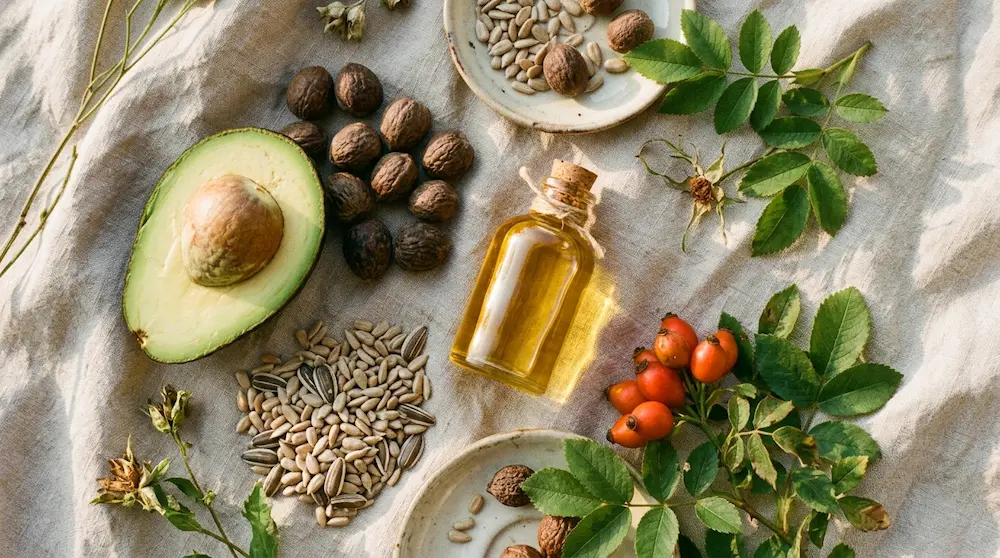
Your skin barrier is largely made up of fats, and the quality of those fats determines how well your skin holds moisture, resists irritation, and looks healthy. Yet most people know little about which fatty acids actually matter and why some oils work so much better than others.
This guide explains the three most important fatty acid groups for skin, compares popular face oils on their fatty acid profiles, and tells you which type of fatty acid suits your skin type.
What Are Fatty Acids?
Fatty acids are the building blocks of fats and oils. They consist of chains of carbon atoms with hydrogen and oxygen atoms attached. The length of the chain and the number of double bonds determine the properties of the fatty acid.
There are saturated fatty acids (no double bonds, like in coconut and palm oil) and unsaturated fatty acids (one or more double bonds). For the skin, unsaturated fatty acids are the most interesting, they are flexible, absorb well into the skin, and play an active role in the skin barrier.
Fatty acids with multiple double bonds are called polyunsaturated, also known as PUFAs (polyunsaturated fatty acids). Fatty acids with exactly one double bond are monounsaturated, like oleic acid.
The Three Most Important Fatty Acid Groups for Your Skin
Linoleic Acid (Omega-6)
Linoleic acid is by far the most studied fatty acid in skincare. It is an essential fatty acid, meaning your body cannot produce it on its own, you depend on external sources.
In the skin, linoleic acid is a direct building block for ceramide-1 (also called acylceramide), a specific ceramide that glues the skin cells together and keeps the barrier watertight. A deficiency in linoleic acid measurably leads to drier, flakier skin with increased transepidermal water loss (TEWL).
Linoleic acid has a light molecular structure and penetrates well into the epidermis. It is especially suited for dry, sensitive, or acne-prone skin. Research shows that people with acne have lower linoleic acid concentrations in their sebaceous glands on average, which increases the comedogenic activity of sebum.
Oleic Acid (Omega-9)
Oleic acid is a monounsaturated fatty acid that your body can produce itself. In face oils like olive oil and avocado oil it is present in high concentrations.
It works as a powerful emollient: it melts at body temperature, softens the skin, and creates a protective film. Oleic acid has a larger molecule than linoleic acid and is absorbed less quickly, meaning it sits more on the skin than it penetrates into it.
That makes oleic acid ideal for mature, very dry, or rough skin that needs a lot of softening and protection. For oily or acne-prone skin it is less suitable, oils with a lot of oleic acid score higher on the comedogenic scale.
Alpha-Linolenic Acid (Omega-3)
Alpha-linolenic acid (ALA) is the plant-based omega-3 fatty acid. Like linoleic acid, it is an essential fatty acid. In face oils, you find it most often in rosehip oil (up to 33%), flaxseed oil (up to 55%), and kukui oil (about 29%).
ALA has a proven anti-inflammatory effect: it inhibits the production of pro-inflammatory eicosanoids in the skin. That makes it especially useful for red, irritated, or reactive skin. It also supports skin barrier repair after damage.
Because ALA is polyunsaturated, it oxidizes relatively quickly. Oils with high ALA content should be stored cool and dark, and they have a shorter shelf life than oils with mainly oleic acid.
Fatty Acid Profiles of Popular Face Oils
Not all oils are equal. The ratios between fatty acids determine which skin type and goal an oil is suited for.
| Oil | Linoleic Acid (omega-6) | Oleic Acid (omega-9) | Alpha-Linolenic Acid (omega-3) | Suited For |
|---|---|---|---|---|
| Kukui oil | ~42% | ~29% | ~29% | All skin types, combination, sensitive skin |
| Argan oil | ~35% | ~49% | ~0% | Dry and mature skin, hair |
| Rosehip oil | ~44% | ~15% | ~33% | Sensitive, mature, and damaged skin |
| Jojoba oil | ~5% | ~10% | ~0% | Wax esters - mimics sebum, all skin types |
| Coconut oil | ~2% | ~6% | ~0% | Body care - comedogenic on the face |
Jojoba deserves a separate note: technically it is not an oil but a liquid wax, made up of wax esters rather than triglycerides. That makes it extremely stable and non-oxidizing, but its skin penetration and fatty acid profile are fundamentally different from true plant oils. More on this in the guide on carrier oils.
Which Fatty Acid Suits Your Skin?
The choice depends on your skin type and goals.
Choose linoleic acid-rich oils if you:
- Have oily or acne-prone skin
- Struggle with clogged pores
- Want a light, fast-absorbing oil
- Are working on repairing your skin barrier
Choose oleic acid-rich oils if you:
- Have very dry or rough skin
- Have mature skin that needs extra nourishment
- Want a richer, more emollient oil
- Want to treat dry patches on the body
Add alpha-linolenic acid if you:
- Have red, irritated, or reactive skin
- Experience rosacea symptoms or general sensitivity
- Want extra support for your skin during recovery from irritation
Curious about your skin type? Take the skin type test and discover which fatty acids your skin needs.
For most people, an oil that combines all three groups is the most versatile choice, and that is exactly where kukui oil stands out.
Note: Research published in the Journal of Investigative Dermatology shows that acne-prone skin has measurably lower linoleic acid concentrations in the sebaceous glands. This lower content makes sebum thicker and more likely to stick to follicle walls, increasing the chance of comedones. Oils high in linoleic acid can locally replenish this deficiency.
Why Kukui Oil Is Special
Most face oils are dominant in one fatty acid group. Olive oil is mostly oleic acid, rosehip is high in linoleic acid and ALA but low in oleic acid, and argan contains almost no omega-3.
Kukui oil is a rare exception. With about 42% linoleic acid, 29% oleic acid, and 29% alpha-linolenic acid, it offers a nearly equal distribution across all three fatty acid groups. That makes kukui oil versatile: it strengthens the skin barrier (linoleic acid), softens and nourishes (oleic acid), and calms irritation at the same time (ALA).
This triple profile is almost unique among plant face oils. More about the origin and composition of kukui oil is in the basic guide on kukui oil and about its effect on the skin in kukui oil for skin.
Tip: Combine a linoleic acid-rich oil like kukui with a ceramide moisturizer for optimal skin barrier repair. The linoleic acid provides the building blocks, the ceramides directly seal the barrier. More about this process is in the guide on skin barrier repair.
Want to know which fatty acids are in a specific oil? Always look at the Certificate of Analysis (CoA) from the manufacturer, exact percentages can vary slightly per harvest and pressing.
Further Reading
Frequently asked questions
What is the difference between omega-3, omega-6, and omega-9?
Omega-3 (alpha-linolenic acid) and omega-6 (linoleic acid) are essential fatty acids your body cannot produce on its own, you get them through diet or skincare. Omega-9 (oleic acid) your body can produce itself. For the skin, omega-3 and omega-6 serve different roles: linoleic acid (omega-6) is a direct building block for ceramides and strengthens the skin barrier, while alpha-linolenic acid (omega-3) mainly has a calming and anti-inflammatory effect.
Does acne-prone skin benefit from oil with linoleic acid?
Yes, oils with a high linoleic acid content are actually well suited for acne-prone skin. Research shows that acne-prone skin has measurably lower linoleic acid concentrations in the sebaceous glands. Oils high in linoleic acid - like kukui oil, rosehip, and sunflower - are lightweight and non-comedogenic, making them a better choice than heavy oils with a lot of oleic acid such as coconut or olive oil.
Can I get fatty acids through food for my skin?
Absolutely. Fatty acids you consume also reach the skin, but the route is indirect. Topical application - applying directly to the skin - delivers a higher local concentration and a direct effect on the skin barrier. Both approaches complement each other. Fatty fish, flaxseed, and walnuts are good sources of omega-3, while sunflower and corn oil are rich in omega-6.