Carrier Oil: What It Is and How to Choose One
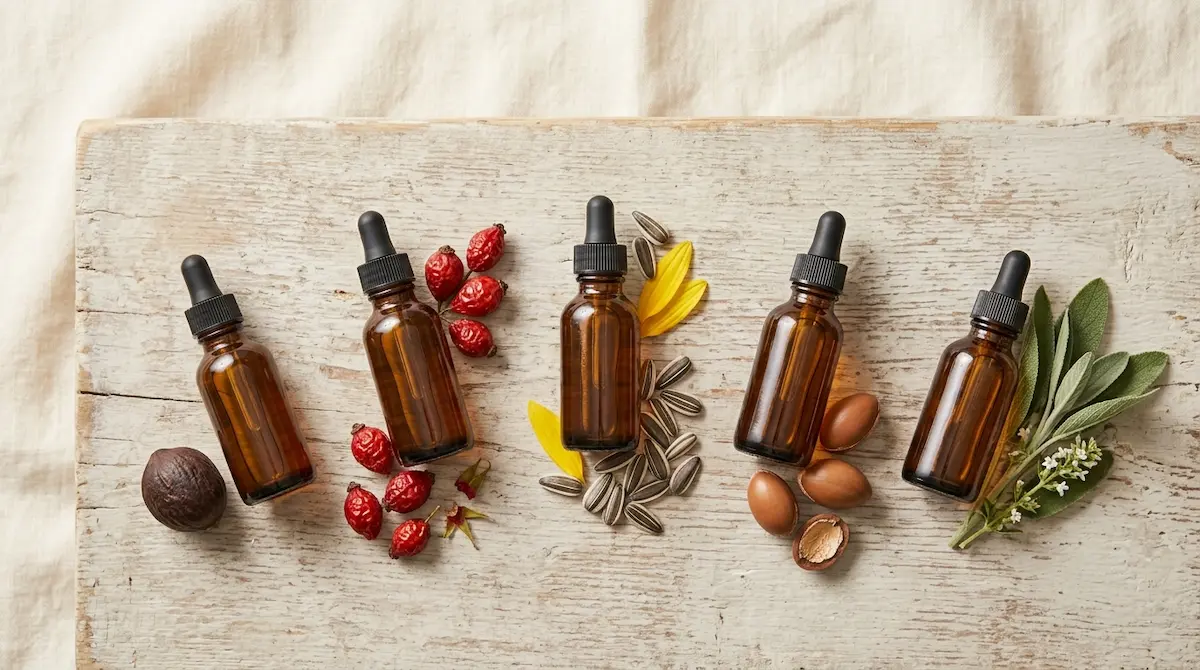
If you work with essential oils, make your own skin care, or just want to understand what is in your serums and oil blends, you will inevitably come across the term carrier oil. It is one of the most fundamental concepts in plant-based skin care, and at the same time one that often stays unclear. This guide explains what a carrier oil is, how to choose the right one, and how to use it.
What Is a Carrier Oil?
A carrier oil, also called a base oil, is a plant-based oil extracted from the seeds, nuts, or fruits of a plant. The name “carrier” refers to its function: the oil “carries” other substances to the skin, or is used on its own as a base for skin care.
Carrier oils consist mainly of fatty acids, the building blocks of the cell walls in your skin. They are absorbed by the skin and nourish it from within, unlike mineral oil, which only leaves a film on the surface.
Good carrier oils are cold-pressed to keep the naturally occurring nutrients intact. The composition, which fatty acids and in what ratio, largely determines what a carrier oil is best suited for.
Carrier Oil vs Essential Oil
Note: Never use essential oils undiluted on your skin. Essential oils are extremely concentrated plant extracts that can cause skin irritation, burns, or allergic reactions on direct contact. Always dilute them in a carrier oil before applying to skin.
The difference is essential. An essential oil is a volatile, highly concentrated oil that contains the fragrance and active compounds of a plant. They evaporate quickly and are often too aggressive for direct skin contact.
A carrier oil is non-volatile, has an oily texture, and stays on the skin. They are mild and suitable for direct use. When combined with essential oils, the carrier oil provides safe dilution and helps spread the active compounds from the essential oil across the skin surface.
The Most Popular Carrier Oils Compared
The comedogenic rating shows how likely an oil is to clog pores, on a scale from 0 (does not clog) to 5 (clogs strongly). More about these ratings in our guide on comedogenic ratings.
| Oil | Best skin type | Comedogenic rating | Notable quality |
|---|---|---|---|
| Kukui oil | All skin types, including sensitive and oily | 2 | Light, fast-absorbing, rich fatty acid composition |
| Argan oil | Normal to dry | 0 | High vitamin E, antioxidant, non-comedogenic |
| Jojoba oil | All skin types, acne-prone | 2 | Technically a liquid wax, very stable |
| Rosehip oil | Mature skin, scar treatment | 1 | Rich in polyunsaturated fatty acids and beta-carotene |
| Coconut oil | Dry, normal - not for acne-prone | 4 | Very nourishing, good melting properties, high comedogenic rating |
How to Choose the Right Carrier Oil for Your Skin Type
The choice depends on two things: your skin type and what you want from the oil. For oily or acne-prone skin, light, non-comedogenic oils are the safest choice. Argan oil (rating 0) and rosehip oil (rating 1) are good options. Kukui oil (rating 2) is also well tolerated by most people with oilier skin, partly thanks to its light texture and quick absorption.
For dry or mature skin, you can go for richer oils that work more occlusively and lock in moisture. Coconut oil is nourishing but has a high comedogenic rating, only use it if you know your skin handles it well.
Tip: Mix carrier oils freely. A blend of jojoba (base, stability) with rosehip (active performance) and a drop of vitamin E oil (preservation) is a classic combination for mature skin. Blending lets you combine the properties of multiple oils and fine-tune them for your skin.
Not sure what your skin type is? Determine your skin type with our quiz to help you pick the right carrier oil.
For sensitive skin, oils with a high linoleic acid content, like kukui and rosehip, are often well tolerated. Linoleic acid is one of the fatty acids naturally present in the skin barrier and helps repair a disrupted barrier.
Blending Carrier Oil with Essential Oil
The standard dilution for adults is 2-3% essential oil. That sounds small, but essential oils are so concentrated that this is enough for effective results.
In practice: for 10 ml of carrier oil (2 teaspoons), use 4-6 drops of essential oil for a 2% dilution. Some examples:
- Lavender oil (2-3%) in jojoba or argan oil: calming for irritated skin
- Tea tree oil (1-2%) in kukui or jojoba oil: for blemish-prone skin
- Rosewood oil (2%) in rosehip oil: for mature or aging skin
Always start at the lower end of the recommended dilution. Some essential oils, like citrus oils, require extra caution and lower percentages. When in doubt, always do a patch test on the inside of your wrist.
Kukui Oil as a Carrier Oil
Kukui oil is an exceptionally versatile carrier oil. It has a light, non-greasy texture and absorbs quickly, making it a pleasant base for both daily skin care and blends with essential oils.
The rich fatty acid composition, including linoleic acid, alpha-linolenic acid, and oleic acid, makes kukui oil suitable for nearly all skin types. It is also popular with people who have dry, sensitive, or irritated skin, partly because of its calming properties.
Everything about the origin, effects, and uses of this oil is covered in our full guide what is kukui oil.
Frequently asked questions
Can I use carrier oil directly on my skin?
Yes, carrier oils are safe to use undiluted on the skin. They are designed for direct skin care. You can apply them pure, or blend them with other carrier oils or essential oils. Start with a small amount to see how your skin responds.
What is the difference between carrier oil and baby oil?
Baby oil is almost always mineral oil, a petroleum byproduct. Mineral oil is not a plant-based carrier oil, it does not penetrate the skin but sits on top as a film. Carrier oils are plant-based, naturally contain fatty acids and nutrients, and are absorbed by the skin.
How much carrier oil do I use with essential oils?
The standard dilution for adults is 2-3% essential oil in carrier oil. That is 2 to 3 drops of essential oil per 5 ml (1 teaspoon) of carrier oil. For children, pregnant women, or sensitive skin, use 1% or less. Always follow the specific guidelines for each essential oil.